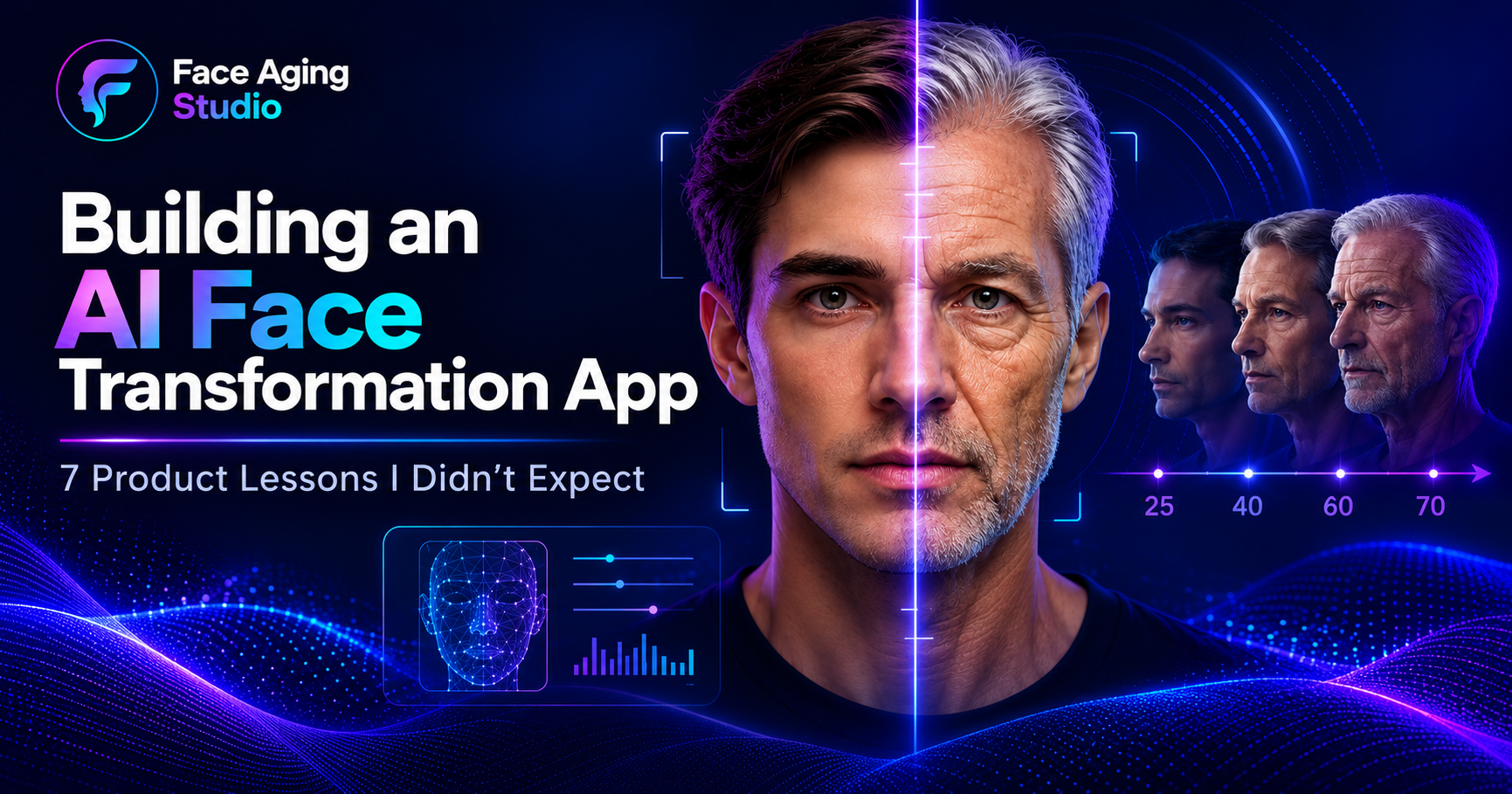
Building an AI Face Transformation App: 7 Product Lessons I Didn’t Expect
What building a real-world generative AI image product taught me about UX, identity preservation, trust, latency, privacy, and product design.
Artificial intelligence has made image transformation look deceptively simple.
From the outside, an AI face transformation app can appear to be little more than an image upload, an API request, and a generated result.
In reality, building a generative AI product that real users can understand, trust, and enjoy is much more complicated.
While developing Face Aging Studio, an AI-powered project focused on facial age progression and generative image transformation, I discovered that the AI model itself is only one part of the product.
The real challenges often appear around the model: identity preservation, image quality, user expectations, latency, privacy, error handling, interface design, infrastructure, and the way AI-generated results are presented.
Here are seven product lessons that surprised me most while building an AI face transformation experience.
1. Realism and Identity Preservation Are Not the Same Thing
One of the first assumptions I had to reconsider was that a more realistic generated image automatically meant a better result.
That is not always true.
A generative AI model can create an extremely realistic older face while simultaneously changing enough facial characteristics that the original person no longer recognizes themselves.
For an AI face transformation product, the real challenge is therefore not simply:
Can the model create an older face?
The more important question is:
Can the model create an older version of this specific person?
This distinction completely changes how output quality should be evaluated.
Wrinkles, gray hair, skin texture, facial volume, and other aging signals can be reproduced convincingly by modern image-generation models.
Preserving recognizable identity while introducing those changes is much harder.
The strongest result is often not the most dramatic transformation.
It is the one where the user immediately thinks:
“That still looks like me.”
This lesson extends far beyond facial age progression.
Any AI product involving personal identity—virtual try-ons, hairstyle simulations, makeup tools, AI avatars, digital twins, or persistent characters—needs to balance transformation with recognition.
In many consumer AI applications, identity consistency can matter more than photorealism.
2. AI Product UX Starts Before the Model Runs
The quality of an AI-generated image depends heavily on the input.
A clear, front-facing portrait with good lighting gives a face transformation model far more useful information than a distant, blurry, heavily angled, or partially obstructed image.
Technically, this is obvious.
From a product perspective, however, it creates an important UX problem.
Users should not have to discover input requirements by generating several poor results.
A good upload experience should help the user succeed before the AI process even begins.
The interface should clearly communicate:
what image formats are supported,
what kind of photograph works best,
whether one or multiple faces are allowed,
whether the face should be front-facing,
what happens after upload,
and how easily the user can replace the image.
This leads to one of the most useful lessons I learned:
Good UX can improve AI output without changing the AI model.
Sometimes the best AI optimization is not another model, another prompt, or another inference parameter.
It is simply better product design.
If the interface guides users toward better inputs, generation quality improves automatically.
For generative AI products, input design is part of model performance.
3. Users Can Interpret AI-Generated Futures as Predictions
Facial age progression creates an unusual psychological challenge.
When someone sees a realistic portrait of themselves at age 60, 70, or 80, the result can feel predictive.
But generative AI is not predicting an individual's biological future.
It is generating a plausible visual interpretation based on patterns learned from many images.
Real-world aging depends on factors the model cannot know:
genetics,
lifestyle,
health,
sun exposure,
stress,
sleep,
smoking,
nutrition,
exercise,
environment,
cosmetic procedures,
and future medical treatments.
The AI does not know those future variables.
That means product language matters.
An age-progressed image should be presented as a possible visualization, not as an exact prediction.
For example:
This image is an AI-generated interpretation of how your appearance could evolve over time.
That kind of wording helps users build a correct mental model of what the technology is doing.
This is important far beyond face aging.
AI products become less trustworthy when they imply more certainty than the underlying system actually has.
Transparency does not make an AI product less impressive.
In many cases, it makes the experience more credible.
4. Latency Becomes Part of the Product Experience
Traditional web applications are designed to feel immediate.
Click a button, retrieve data, update the interface.
Generative AI changes that expectation.
Image generation can take several seconds or longer depending on model load, network conditions, image complexity, infrastructure, and processing requirements.
Technically, the system may be working perfectly.
Psychologically, the user may think the application has frozen.
That means waiting can no longer be treated as a purely technical issue.
It becomes part of the UX.
A blank loading spinner is rarely enough.
The interface should reassure users that something meaningful is happening.
Messages such as:
“Creating your future portrait…”
or
“Generating your transformation…”
can change the perceived waiting experience significantly.
The goal is not to make the system appear faster than it really is.
The goal is to make waiting understandable.
This is especially important in AI image products because users are emotionally invested in the output.
A user waiting for a database query is waiting for information.
A user waiting for an AI-generated version of their own face is waiting for something personal.
That makes the same five-second delay feel very different.
5. Error Handling Matters More in Generative AI
Generative systems fail differently from traditional software.
Sometimes an API request fails.
Sometimes an uploaded image is unsuitable.
Sometimes a model produces an unexpected result.
Sometimes the generation technically succeeds but the visual result is poor.
Sometimes processing simply times out.
These situations cannot all be handled with a generic error message.
A message such as:
“Error 500.”
means almost nothing to a normal user.
Good AI error handling should answer three questions:
What happened?
Did I lose anything?
What should I do next?
For example:
We couldn't process this photo. Try another image with a clear, front-facing face and good lighting.
That turns a technical failure into an actionable next step.
This matters because probabilistic systems make occasional failures unavoidable.
A strong AI product is not one that never fails.
It is one that fails gracefully.
There is also a business-model implication.
If an application uses a credit-based system, developers need to decide what happens when generation fails.
Should a failed request consume a credit?
Should the credit automatically be refunded?
Should certain types of failure be handled differently?
These details may seem small, but they have a disproportionate impact on user trust.
6. Privacy Is Part of the Interface
Facial images are deeply personal.
Users may upload photographs of themselves, partners, friends, or family members.
That creates responsibilities beyond ordinary image processing.
Privacy cannot be treated only as a legal document hidden in the footer.
It should also be part of the product experience.
Users naturally want to understand:
why the application needs their image,
how it is processed,
whether it is stored,
how long it is retained,
who can access it,
and what happens to the generated result.
Consent also matters.
The fact that technology can transform another person's face does not automatically mean every possible use is appropriate.
As AI-generated imagery becomes more realistic, developers need to think carefully about how users understand synthetic content.
This leads to a broader principle:
Trust architecture is part of product architecture.
A system can have excellent encryption, authentication, and infrastructure while still making users uncomfortable if the interface does not explain what is happening.
Trust has both technical and psychological dimensions.
The best consumer AI products need both.
7. The AI Model Is Only a Small Part of the Product
This may be the biggest lesson of all.
At the beginning of an AI project, it is easy to focus almost entirely on the model.
Which model should I use?
Which API produces the best images?
Which parameters improve quality?
Which prompt works best?
Once the application evolves into a real product, those questions become only one part of a much larger system.
A production AI application eventually needs to manage things such as:
frontend UX,
backend infrastructure,
authentication,
user accounts,
image processing,
payments,
credit systems,
API communication,
failed generations,
analytics,
security,
storage,
responsive design,
performance,
and application state.
The challenge stops being:
“How do I call an AI model?”
It becomes:
“How do I make all of these systems feel like one simple product?”
That is a very different engineering problem.
From the user's perspective, the ideal experience should remain simple:
Upload a photo.
Choose a transformation.
Generate the result.
Everything behind those three steps is complexity the product should absorb.
The Hidden Challenge of Consumer AI: Managing Expectations
There is another pattern connecting all seven lessons.
Modern AI creates extremely high expectations.
Users have seen spectacular demonstrations of generative technology on TikTok, YouTube, Instagram, and product launch pages.
They expect:
instant results,
perfect realism,
flawless identity preservation,
zero failures,
and almost unlimited creative control.
Production software rarely behaves that perfectly.
This creates an expectation gap.
One temptation is to solve that gap through aggressive marketing promises.
A healthier strategy is to design the product so users understand what the AI is actually good at.
The goal should not be to make the system appear magical at every moment.
The goal should be to make it feel reliable.
Reliability often creates more long-term value than surprise.
Why Simplicity Matters More as AI Becomes More Powerful
Generative AI products tend to accumulate controls quickly.
Model selection.
Prompt settings.
Transformation strength.
Seeds.
Resolution.
Guidance values.
Style parameters.
Advanced generation settings.
For technical users, these controls can be useful.
For consumers, they can become overwhelming.
A powerful AI product does not necessarily need a powerful-looking interface.
Often, the opposite is true.
The more sophisticated the underlying technology becomes, the more valuable simplicity becomes.
Someone interested in facial age progression does not necessarily want to understand diffusion models, inference settings, prompt engineering, or guidance scales.
They want an answer to a very simple question:
“What might I look like later in life?”
The interface should respect that simplicity.
AI Product Development Is Becoming Its Own Discipline
Building generative AI applications increasingly feels different from traditional software development.
The product sits at the intersection of several disciplines:
software engineering,
machine learning,
UX design,
product management,
privacy,
behavioral psychology,
infrastructure,
and AI ethics.
That combination creates unusual product decisions.
A designer needs to understand model limitations.
A developer needs to understand user psychology.
A product owner needs to understand inference costs and latency.
An AI engineer needs to understand how generated output will actually be interpreted by users.
These boundaries are becoming increasingly blurred.
That is one reason generative AI product development is so interesting.
What I Would Do Differently Today
If I started an AI image product again from zero, I would focus earlier on the complete user journey instead of concentrating so heavily on the generation model.
I would validate these questions as early as possible:
Can users understand the core value proposition immediately?
Can they upload the correct type of image without help?
Do they understand what the AI result represents?
Does the waiting experience feel intentional?
Are failures actionable?
Is privacy explained clearly?
Does the user still recognize themselves in the result?
Can someone use the product without understanding AI?
These questions are much closer to the real product than benchmark scores or model specifications.
The Real Competitive Advantage May Not Be the Model
AI models are improving rapidly.
Capabilities that were difficult to access a few years ago are becoming available through APIs to individual developers and small teams.
That means model access alone is unlikely to remain a durable competitive advantage.
Different products may eventually use the same or very similar underlying AI capabilities.
The differentiation will increasingly come from everything around the model:
UX,
trust,
brand,
speed,
workflow,
reliability,
specialization,
community,
and product insight.
The winning AI product may not always have the technically strongest model.
It may simply understand its users better.
Final Thoughts
The biggest surprise from building an AI face transformation product was realizing how much of the final user experience exists outside the AI model itself.
The model matters enormously.
But a strong model inside a confusing, slow, opaque, or untrustworthy experience still produces a weak product.
The most important product work happens around the AI.
Help users provide good inputs.
Preserve what matters in the output.
Explain uncertainty honestly.
Design waiting states intentionally.
Handle failure gracefully.
Treat privacy as part of the interface.
Hide unnecessary technical complexity.
And design around the way people actually experience the technology.
Generative AI is making extraordinary capabilities available to increasingly small development teams.
But access to powerful AI does not automatically create a powerful product.
The real advantage may come from something much less glamorous:
understanding how humans actually experience AI.
That is where some of the most interesting work in AI product development is only beginning.
About the author
- Face Aging Studio explores AI-powered facial transformation, age progression and generative imaging through accessible web and Windows experiences.
Comments
Join the discussionNo comments yet. Be the first to comment.